





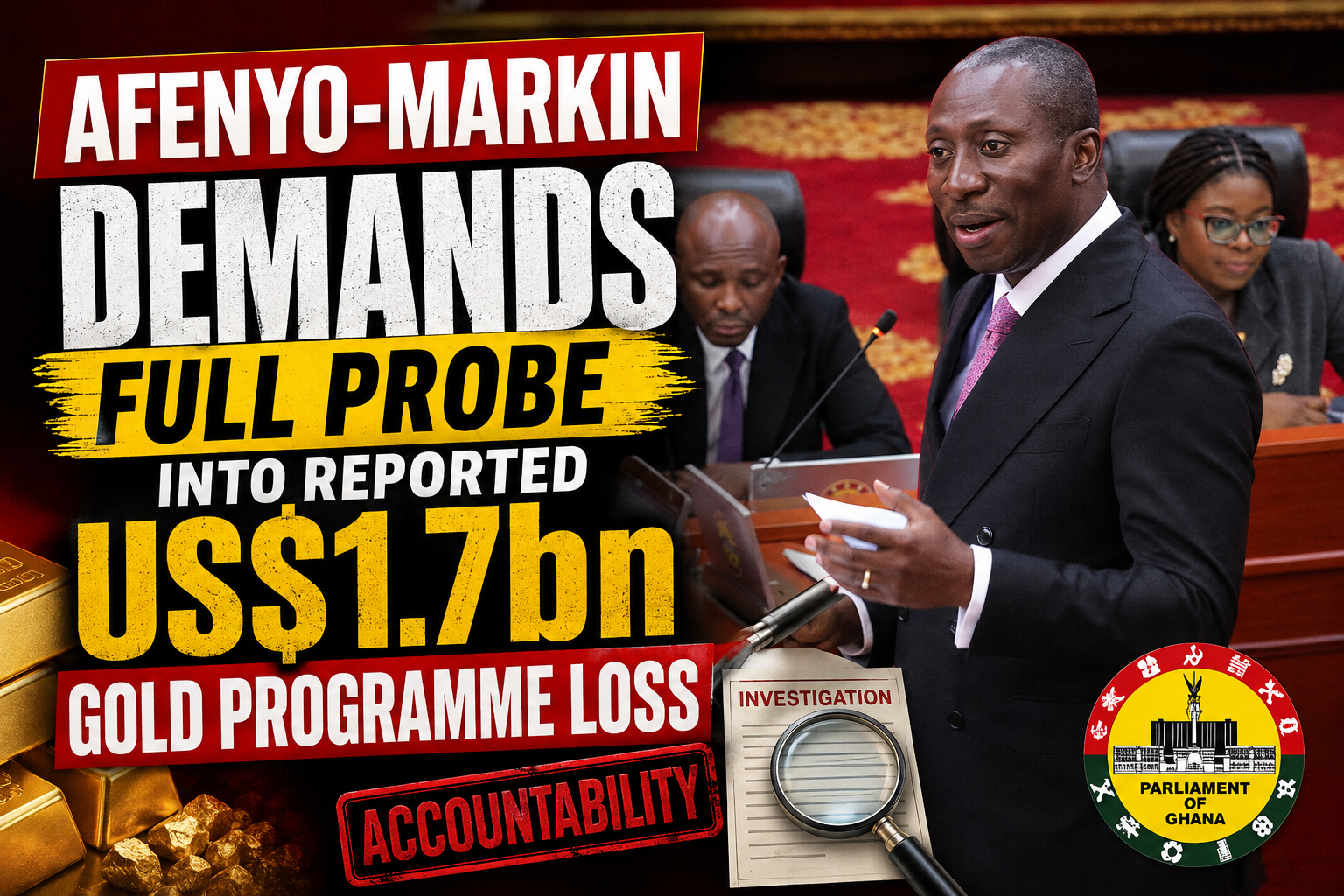
Accra, August 24, 2026 — Minority Leader in Parliament, Hon. Alexander Afenyo-Markin, has called for a full-scale parliamentary investigation into the reported US$1.7 billion loss associated with the domestic gold purchase programme involving the Bank of Ghana.
Speaking during Parliament’s emergency sitting on Monday, Mr. Afenyo-Markin said the reported loss, which he estimated at approximately GH¢22 billion at current exchange rates, was too significant for Parliament to ignore.
He said the programme was originally intended to protect Ghana’s gold resources, strengthen the cedi and support the country’s economy.
Minority files motion for ad hoc committee
Mr. Afenyo-Markin disclosed that the Minority had filed a motion on August 20, 2026, seeking the establishment of an ad hoc committee to investigate the reported loss in full.
According to him, the proposed committee should have the authority to summon documents and witnesses and establish the facts surrounding the loss.
He said the Minority wants Parliament to determine exactly how the US$1.7 billion loss occurred, including:
- How much was lost through foreign exchange movements.
- How much resulted from the prices at which gold was purchased.
- The decisions and circumstances that contributed to the reported loss.
- The overall financial impact on the Bank of Ghana and the Ghanaian taxpayer.
“Not a summary. Not a slogan. A full account of how much of that 1.7 billion dollars was lost.”
Cites IMF report
Mr. Afenyo-Markin also referred to an IMF report dated December 17, 2025, which he said raised concerns about losses from the domestic gold purchase programme and Gold Fields activities.
He argued that the issue requires parliamentary scrutiny to ensure that those responsible for implementing public policy account to the people of Ghana.
“The public will bear the cost”
The Minority Leader further warned that the consequences of losses that erode the Bank of Ghana’s capital could ultimately extend to ordinary Ghanaian taxpayers.
He explained that where the central bank requires recapitalisation because of significant losses, public resources could be required to restore its financial position.
“That is not a technical matter for economists alone. That is a matter of urgent public importance for this House.”
Mr. Afenyo-Markin maintained that Parliament must not remain silent on the reported loss and said the Minority would pursue the matter as an issue of urgent public importance.
Our Democracy News will continue to monitor proceedings and developments surrounding the Minority’s proposed investigation.