



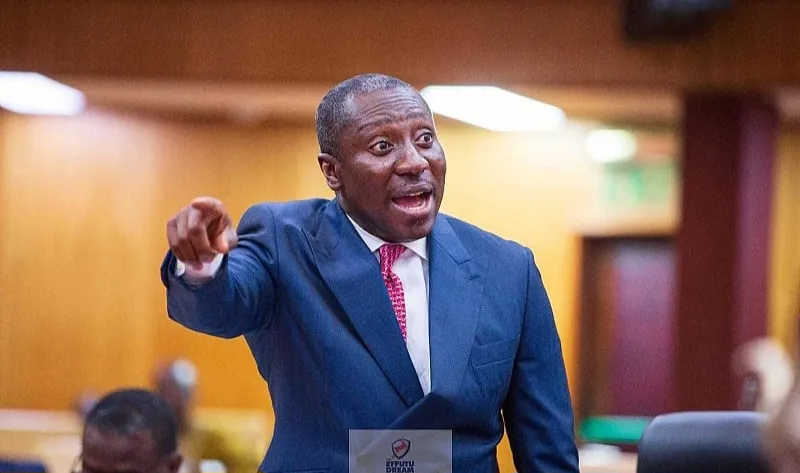
The Minority Leader in Parliament, Osahene Alexander Afenyo-Markin, has called for an urgent, technology-driven response to illegal mining, warning that galamsey continues to pose a serious threat to Ghana’s water bodies, public health, and national security.
Speaking at a public lecture, Afenyo-Markin described illegal mining as a “systemic crime” that requires decisive state action beyond rhetoric. He advocated a total ban on mining in river channels and protected forest areas, stressing that Ghana cannot reclaim its degraded environment without firm enforcement backed by evidence and data.
He argued that government efforts have failed largely because attention has been placed on small-scale miners while the financiers and organized syndicates behind galamsey remain untouched. According to him, targeting these powerful actors is the only sustainable way to dismantle the illegal mining economy.
Beyond enforcement, the Minority Leader emphasized the need for reclamation of degraded lands and the provision of alternative livelihoods for families affected by the clampdown on illegal mining, warning that environmental justice must go hand in hand with social protection.
Looking ahead, Afenyo-Markin positioned Artificial Intelligence (AI) as a critical tool for Ghana’s development, particularly in agriculture, healthcare, and environmental protection. He noted that AI could enable real-time monitoring of protected areas, detect illegal mining activities faster than traditional patrols, and support early intervention.
He further highlighted AI’s potential to improve governance by assisting Parliament and institutions such as the National Development Planning Commission with data-driven policy analysis, long-term development modeling, and enhanced transparency in public decision-making.
In agriculture and healthcare, he pointed to AI-powered solutions such as soil analysis and crop advisory systems for smallholder farmers, as well as early disease detection tools, which could significantly improve livelihoods and public health outcomes.
Afenyo-Markin concluded by urging policymakers to embrace innovation, stating that “Ghana must move from reactive governance to evidence-based planning if we are to heal our environment and secure our future.”