






At least eight people have been killed and 18 others injured after an explosion ripped through a mosque during Friday prayers in the Syrian city of Homs, according to the country’s health ministry.
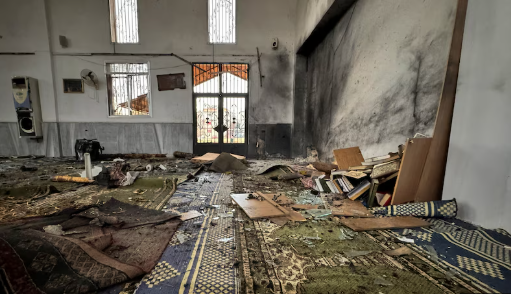
Images released by Syria’s state-run news agency, SANA, showed extensive damage inside the Imam Ali ibn Abi Talib Mosque, with blackened, scorched walls, shattered windows and bloodstained carpets.
Security officials believe the blast was caused by an explosive device detonated inside the mosque, SANA reported, citing a security source.
While investigations are ongoing to identify those behind the attack, the jihadist group Saraya Ansar al-Sunnah has claimed responsibility.
The mosque is located in the Wadi al-Dhahab neighbourhood, an area predominantly inhabited by members of the Alawite ethnoreligious group.
Syria’s Foreign Ministry condemned the incident, describing it as a “terrorist crime.” In a statement posted on X, the ministry said the “cowardly act” was a blatant violation of human and moral values and aimed at undermining the country’s security and stability.
Saraya Ansar al-Sunnah, a Sunni extremist group, said it carried out the attack in collaboration with another unidentified group, using explosives planted at the site.
The group’s unclear origins and opaque affiliations have raised questions among analysts, particularly since it emerged more prominently in June after claiming responsibility for a deadly church bombing in Damascus.
Some observers have suggested the group may be acting as a front for the Islamic State (IS), citing similarities in rhetoric and the nature of its targets.
The claim comes after months of relative inactivity by Saraya Ansar al-Sunnah, whose previous attacks reportedly focused on targeted killings of minorities and individuals it describes as remnants of the former government of Bashar al-Assad.
The attack occurred nearly a year after Syrian rebel forces overthrew Assad, an Alawite whose sect is an offshoot of Shia Islam and represents one of Syria’s largest religious minorities.
Since Assad’s fall and subsequent flight to Russia, where he and his family were granted asylum, Syria has experienced repeated waves of sectarian violence.
Alawite communities have expressed fears of reprisals and have been subject to security crackdowns.
In March, security forces were accused of killing dozens of Alawites in the coastal province of Latakia, according to the Syrian Observatory for Human Rights (SOHR).